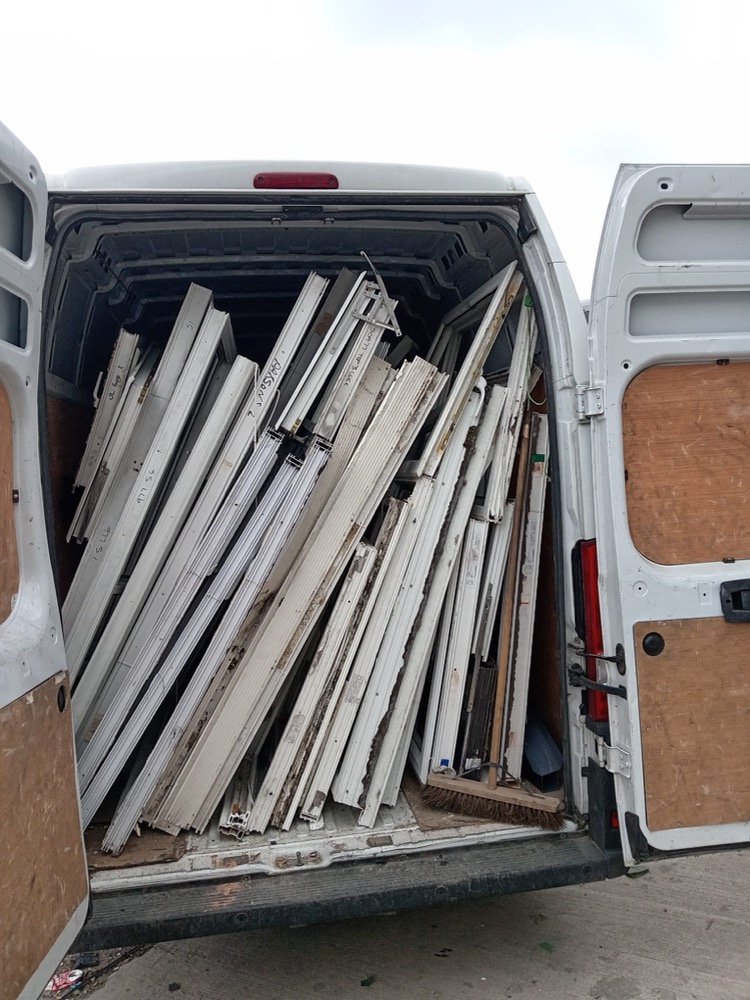
Trade collection from Wigan to Bolton, Salford to Stockport — what we cover from our Wigan hub and how same-day works in one of the densest window markets in the UK.
Why Greater Manchester is a uPVC heavyweight
Greater Manchester is one of the most concentrated regions of UK window trade, and it has been for decades. The combination is straightforward: a large pre-1990s housing stock progressively re-glazed across multiple cycles, a long-established fabrication corridor running from Wigan and Bolton through to Oldham and Rochdale, dense suburban installer activity across all ten metropolitan boroughs, and the M60 ring giving you most of the patch within an hour of any decent depot location.
The output, in waste terms, is a constant flow of post-consumer uPVC frames coming off install jobs, manufacturing offcuts coming out of fabrication units, and bulk strip-outs coming off social housing programmes and commercial refurb. It's a region that suits a specialist recycler with multiple vehicles, not a national skip company driving in from somewhere else.
That's why we run a hub from Wigan. It puts us inside the patch rather than serving it from outside.
The ten boroughs we cover, and beyond
Greater Manchester proper is the ten metropolitan boroughs. From the Wigan hub we cover all of them:
- Manchester — city centre, north and south Manchester, Wythenshawe, Didsbury, Chorlton.
- Salford — including Eccles, Worsley, Swinton, Walkden, Irlam.
- Trafford — Stretford, Sale, Altrincham, Urmston.
- Stockport — Stockport town, Bramhall, Cheadle, Marple, Hazel Grove.
- Tameside — Ashton-under-Lyne, Hyde, Stalybridge, Denton.
- Oldham — Oldham town, Chadderton, Royton, Saddleworth.
- Rochdale — Rochdale, Heywood, Middleton, Littleborough.
- Bury — Bury, Radcliffe, Ramsbottom, Whitefield, Prestwich.
- Bolton — Bolton town, Horwich, Westhoughton, Farnworth.
- Wigan — Wigan town, Leigh, Atherton, Ashton-in-Makerfield, Tyldesley.
From the same hub we run overflow routes into the surrounding belt where the trade clusters spill across the boundary: Warrington and St Helens to the west, Preston and Chorley to the north, Skelmersdale and Ormskirk into West Lancashire, and into Merseyside — Liverpool, Bootle, Sefton — when the route works. South of the city we pick up Macclesfield and the north Cheshire belt, with the Stoke-on-Trent hub taking over further south.
If your postcode starts WN, BL, M, SK (north), OL, BB (south), PR, WA, L (north) or sometimes LA — you're in our Wigan patch. Postcodes outside that get covered by one of our other four hubs, usually with the same response time.
Same-day, in practice
"Same-day collection" is one of those phrases everyone in the trade has heard and very few national operators actually deliver. From Wigan, in this region, it's real — and it's worth saying what it actually requires.
Three things make it work:
- Multiple vehicles on the road every day. Not a single van running a fixed route. We have several units running concurrent collections, which is why the morning call slots into a route somewhere.
- A hub inside the patch. Wigan to Manchester city centre is around 40 minutes on a clear M61. Wigan to Stockport, an hour. Wigan to Bolton, twenty minutes. There is no postcode in Greater Manchester that can't be reached within an hour of the depot.
- A trade-shaped booking process. Phone, photos by email, postcode, rough volume, contact on site. No procurement portal, no 14-day onboarding, no minimum tonnage gate. The dispatcher gets the job onto a route the same morning if it lands before midday — same week at the latest.
What same-day doesn't mean: a guarantee on a 4pm call when every van is already 50 miles away. It means realistic, regular same-day on the kind of trade volumes we're set up to handle. Larger bulk loads — full container swaps, multi-vehicle strip-outs — typically schedule two or three days ahead so we can route the right kit.
Who we collect from in Greater Manchester
Five segments make up the bulk of what we lift across the patch. Each has slightly different mechanics.
Window fabricators
The fabrication corridor across Bolton, Wigan, Oldham and Rochdale produces a steady stream of profile offcuts, trim and beading. Cleanest material in the system. We supply storage cages on site, schedule weekly or fortnightly pickups, and pay a rebate against tonnage. For the larger fabricators this turns a former waste line into a small but real revenue line.
Retail installers
Installation companies running daily replacement work across the suburbs — Trafford, Stockport, Bury, Salford. Frames pile up at the yard between collections. We do single van loads through to large weekly lifts. No minimum tonnage, no fixed schedule unless you want one. Most installers in this segment go from "skip hire by default" to "free collection on call" within a single quarter once they've moved over.
Social housing and council programmes
Greater Manchester has a substantial social housing stock and an ongoing programme of planned window replacement across local authority and housing association portfolios. Volumes are big, paperwork requirements are real — full duty-of-care chain, electronic Waste Transfer Notes within 24 hours under Section 34 EPA 1990, annual recycling reports for environmental returns. We run those contracts the same way we run a single van load: just bigger vehicles and a fixed point of contact.
Demolition and strip-out contractors
Mill conversions, commercial refurb, old industrial buildings being repurposed across the boroughs — Greater Manchester has a constant pipeline. Frames come out in volume, often alongside glass from old commercial glazing. We place containers for the duration of the project and remove when full. The non-uPVC site waste — wood, hardcore, mixed — sits on a separate skip conversation but we can usually combine it.
Glass merchants and trade counters
Glaziers and window merchants across the region either generate their own glass and uPVC waste or want a service to offer their installer customers. The trade counter recycling scheme is a turnkey package — branded paperwork, the merchant stays the relationship, we do the collection. It works particularly well in dense regions like Greater Manchester because the customer base is concentrated enough to make the routing efficient.
How a typical collection actually goes
The mechanics, end to end, are deliberately blunt. No procurement, no portal:
- You call or email. Photos help us scope volume — send three or four shots of the load. Tell us the postcode, contact on site, and rough quantity (cages, frames, doors).
- We quote within working hours. Free, rebated, or — rarely — chargeable for awkward access or contamination. You'll know on the call.
- We schedule. Same or next day across Greater Manchester for normal trade loads. Larger jobs scheduled two to three days ahead.
- We collect. Driver loads from your yard, site or container. You sign off the eWTN at the kerb if you want a paper copy — the electronic version emails to your nominated contact within 24 hours.
- The material is processed. uPVC goes for shredding, separation and pelletising. Steel reinforcement out as scrap steel. Glass routed to UK cullet reprocessors. Sealed unit hardware separated. None of it goes to landfill.
- You get the documentation. eWTN within 24 hours. Annual tonnage report on request for environmental and ESG returns.
What the eWTN covers
Every Greater Manchester collection is covered by an electronic Waste Transfer Note, issued under Section 34 of the Environmental Protection Act 1990. It names us as the Upper-Tier Waste Carrier (registration CBDU347776), names your business as the producer, lists the European Waste Catalogue codes, and gives you a chain-of-custody record back to the reprocessor. That's the document Environment Agency officers ask for if they ever come knocking.
Why density beats scale
The argument for using a regional specialist over a national big-skip operator in Greater Manchester comes down to one thing: routing economics. A national operator has to cover the journey from a depot somewhere else, plus their margin, plus the cost of disposing of mixed waste at a transfer station. They don't make the numbers work on uPVC at trade volume — which is why you'll get charged either way.
A regional specialist like us is solving the opposite problem. Inside Greater Manchester we have routes already running daily. Adding your collection to a route that's already going through your postcode costs us very little incrementally. The material has commodity value at the back end. So the lift is free or rebated, and the answer comes back the same morning.
Scale matters at the processing end. Density matters at the collection end. Greater Manchester is the kind of region where density wins.
What we don't do
Worth saying clearly. We're not a homeowner-facing service. If you're a Manchester resident with two old frames in the back of the garage, your route is the local HWRC or a small skip — not us. We're built for trade volumes and trade documentation.
We're also not a one-stop builder's skip operator. The site waste skips we run alongside the uPVC service are an adjacent capability, not the core. If your job is mostly hardcore and timber with a bit of uPVC on top, you'll want a general skip company; if it's mostly uPVC with site waste alongside, we're the right call.
The right test: is uPVC or glass the headline waste stream on this job? If yes, we should be your first call across Greater Manchester. If no, a general operator probably suits.
Booking a Greater Manchester collection
The fastest way to find out whether your job suits a free lift, a rebated collection, or a fixed schedule is a phone call or a few photos by email. Postcode, rough volume, contact on site — we'll come back within working hours with a quote and a date.
If you'd like to see the wider context — what we do beyond uPVC, the other four hubs, how the processing works at the back end — the homepage covers our trade services in full, the processing walk-through covers what happens after we lift, and the Wigan hub page has the local-services view including postcode coverage and overflow areas. From Wigan to Stockport, Bolton to Oldham — same hub, same number, same documentation.