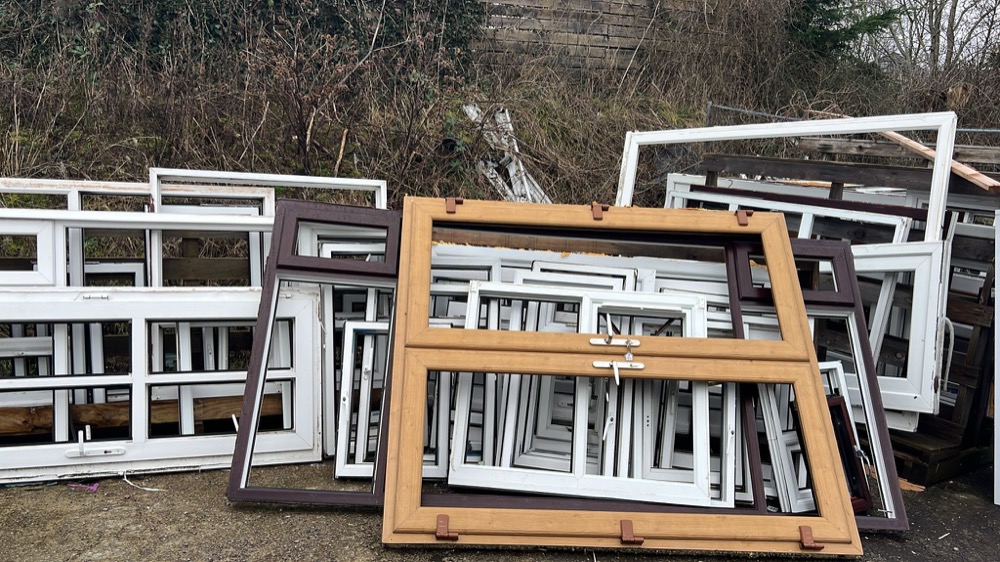
A turnkey guide for window merchants and trade counters: how to offer recycling as a value-add to installer customers without taking on operational headache or compliance risk.
Why the trade counter is the right place for this.
Window merchants, hardware merchants and trade counters sit at a particular pinch-point in the industry. You're not the fabricator. You're not the installer. But you're the place the installer walks into every week, picks up consumables, asks for advice, and where the buying relationship lives. Your category buyers know how thin the margin difference is between branches that retain installers and branches that don't.
That installer relationship is increasingly being shaped by things that aren't price. It's stock availability. It's the trade counter manager who knows the customer's name. It's the after-sales support. And — newer to the conversation — it's whether the branch can help the installer meet expectations they're getting from their customers. One of those expectations, in 2026, is that old windows are taken away and recycled, not skipped.
That's where a trade-counter recycling scheme comes in. Not as a side project. As a value-add bolted to the windows you already sell.
What "table-stakes" now means.
Talk to any installer doing replacement work and they'll tell you the same thing: the homeowner asks where the old windows go. They didn't ask in 2010. They ask in 2026. Sometimes it's an environmental concern, sometimes it's a procurement requirement (for landlord or commercial work), sometimes it's just a casual question. The installer needs an answer that isn't "the skip".
Most installers don't have the volume or the relationship to set up specialist uPVC recycling on their own. They might do five replacement jobs a week. That's not enough to interest most recyclers, and it's not enough for the installer to want to deal with the admin themselves.
If you, as their merchant, can offer a turnkey scheme — call us, we collect, paperwork sorted, your branding on it — you've solved a problem they couldn't solve alone. That's a retention lever. It's also a quiet differentiator versus the merchant down the road who hasn't bothered.
How the customer flow actually works.
The mechanics are simple, and they're designed to keep your branch out of the operational and compliance picture.
- Installer buys windows from your branch. Normal sale, normal terms. Nothing changes about your existing process.
- You offer the recycling scheme as a bolt-on. Could be a tick-box on the order, a leaflet at the counter, a line in the quote pack. The installer says yes for the job they're working on.
- They give us the site details. Either via your branch, or directly to us with your branch reference. We schedule the collection of the old uPVC and any sealed units around the install date.
- We collect, process, and document. The installer's site gets cleared. The material gets routed through proper recycling channels. An eWTN is issued within 24 hours.
- Branded paperwork goes back via you. The installer receives a recycling certificate or summary with your branch's branding on it. They can pass that on to their homeowner or commercial customer.
From the homeowner's perspective, the installer arranged it. From the installer's perspective, the merchant arranged it. From the merchant's perspective, the recycler arranged it. Everyone stays in their lane, everyone keeps the relationship that matters to them.
What your branch actually has to do
- Mention it — at the counter, in quote packs, on the website. The hardest part is making installers aware it exists.
- Capture the lead — name, site postcode, install date. That's it. We do the rest.
- Pass on the paperwork — branded eWTN summary lands with your branch reference; you forward it to the installer if they want a copy for their customer.
The compliance question, head on.
This is where most merchants get nervous, and it's where the answer is cleaner than people assume. Setting up a recycling scheme as a merchant does not make you a waste carrier, a waste producer, or a waste broker.
- The waste producer is the installer. Under Section 34 of the Environmental Protection Act 1990, the moment an installer's fitter lifts a frame off the wall and takes it off site, the installer becomes the waste producer. That sits with them, not with the homeowner and not with you. (We cover this in detail in our piece on waste transfer notes for installers.)
- The waste carrier is us. We're the Environment Agency Upper-Tier registered waste carrier (registration CBDU347776). The collection runs on our licence; the eWTN is issued by us to the installer naming the installer as producer and us as carrier — fully compliant, fully auditable.
- You — the merchant — are the lead source, not a party in the waste chain. Helping your installer customer book a collection doesn't make your branch a producer, carrier or broker. You're providing a service introduction, the same way a builders' merchant might pass on a hire-equipment supplier's number.
- Your branch's branding sits on top of all that. It's a presentation layer — branded counter materials, branded recycling summary back to the installer's customer. It doesn't change who carries what legal duty.
This matters because category buyers routinely ask whether running a "branded recycling scheme" exposes the merchant to additional regulatory burden. It doesn't, provided the chain is set up correctly: installer = producer, us = carrier, you = lead source. The branding is marketing; the compliance chain runs underneath it through the carrier and the eWTN.
What gets branded, what doesn't.
The scheme is genuinely white-label friendly. What the merchant typically brands:
- Counter materials — leaflet, A4 sheet, point-of-sale card.
- The order form or order add-on the installer ticks.
- The recycling summary / certificate that goes back to the installer at the end of the job.
- Email comms from your branch to the installer.
What stays on our paperwork (because legally it has to):
- The eWTN itself — it carries the waste carrier registration, the producer details, and the SIC and EWC codes.
- Internal logistics paperwork — collection notes, tonnage records.
The split is intentional. The installer gets a clean, branded story they can show their customer. The compliance documents underneath are accurate, auditable and unambiguous about who carried the waste.
Single branch, or full network.
We work with merchants on both ends of the scale.
Single branch. You run one trade counter, you want to test the scheme with your installer base before committing to anything bigger. We set up a single-branch arrangement, branded for that branch, with local hub coverage from the nearest of our five operating hubs. You get monthly summary reporting on collections referred from your branch, and you can decide whether to scale.
Multi-branch / national. You run a network — regional or national — and want a consistent recycling proposition across every branch. We set up a single scheme, branded centrally but with branch-level reference codes so each location can track its own conversion. Reporting consolidates at head office; collections happen locally from the nearest hub. The installer experience is identical whichever branch they walked into.
For multi-branch rollouts, the typical pattern is: pilot with two or three branches in our core coverage area (North West, Midlands, Yorkshire), iron out the comms and counter materials, then roll out across the rest of the estate.
How it sits in the new-window sale.
The scheme isn't a separate product. It's an attachment to the windows the installer is already buying from you. The conversation at the counter shifts subtly:
Old: "I need eight casements for a job in Wigan."
New: "I need eight casements for a job in Wigan — and I'll take the recycling scheme too, I've got skips on order I can cancel."
The installer saves on skip hire. They get a tidier story for their homeowner. They don't have to think about waste carrier compliance for that job. From your side, the windows sale is unchanged — you've added a small admin step (capturing the site postcode and install date) and gained a sticky reason for the installer to come back for the next job.
What it costs your branch.
For typical schemes: nothing. We carry the cost of collection on our side because the post-consumer uPVC has end-of-line recycling value that supports the logistics. The merchant doesn't pay a setup fee, doesn't pay per collection, doesn't take on infrastructure.
What we ask in return is straightforward: that you actually market the scheme to your installer base. A scheme that exists on paper but isn't mentioned at the counter does nobody any good. The branches that get most out of this are the ones whose counter staff bring it up unprompted on every relevant order.
For installers who ask about pricing on the standalone disposal side — outside any merchant scheme — we cover the going rates in our piece on the cost of disposing of uPVC windows.
Metrics that tell you it's working.
For category buyers and branch managers thinking about this commercially, the numbers we'd encourage you to watch:
- Collection conversion rate — of installers buying replacement windows from your branch, what percentage are taking the recycling bolt-on? A healthy rate after six months is well above where most schemes sit at launch.
- Repeat installer rate — are installers who used the scheme on one job using it on the next? This is the retention signal that matters.
- Quote-to-order pull-through — are quotes that include the recycling scheme converting at a higher rate than quotes that don't? We've seen merchant data suggest yes, qualitatively.
- Tonnage diverted — for ESG reporting, the volume of uPVC recycled via the scheme — branded under your network — is a number you can report up to head office or use in trade marketing.
Getting it set up.
From first conversation to live scheme is typically two to three weeks. The bulk of that time is on artwork — getting your branch logo, colours and reference codes onto the counter materials and certificate template. The operational side is essentially live from day one because it sits on top of our existing collection infrastructure.
If you're a category buyer, branch manager or operations lead at a window merchant, hardware merchant or trade counter, the conversation to start with is whether your installer base would pick this up. That's the only real question. Everything else — logistics, compliance, branding, reporting — we've got covered.
Drop us a line at info@upvcrecycling.com, or call the team. We'll talk through what your branch network looks like, where the nearest hub is, and what a pilot would look like. The pitch to your installers can be live within the month.