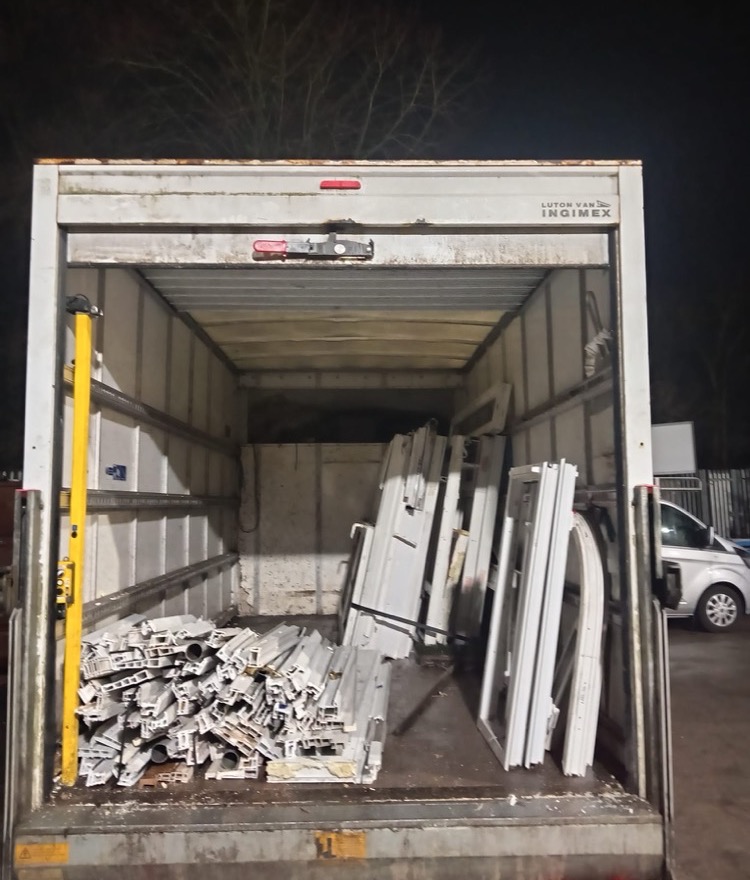
What you'll pay (or get paid) to clear uPVC windows in the UK, in 2026 — by load size, frame condition, and whether you're trade or one-off.
uPVC isn't ordinary waste
Most building waste costs you money to get rid of. uPVC sits in a different category. At the right volume, in the right condition, it has commodity value — the polymer can be shredded, cleaned, separated from steel and glass, and reprocessed into pellets that go straight back into new window profiles, fencing, ducting and garden products. That single fact upends the usual disposal economics.
What it means in practice: if you're trade and you've got a steady stream of frames or offcuts coming out, the question isn't really "how much will this cost me?" — it's "am I in the right disposal route to either get it lifted free, or get paid for it?" Plenty of fabricators are still paying skip hire for material a recycler would happily take off their hands at no charge. Plenty of installers are paying tip fees for frames they could have had collected by a specialist for nothing.
This guide walks through the routes available in the UK in 2026, what each one costs (or pays) qualitatively, and where the breakpoints sit between "use a skip" and "call a recycler". No invented £/tonne figures — pricing in this market moves with polymer markets, fuel and contamination rates, and any number you saw quoted online last year is probably already wrong.
The four routes, ranked by economics
There are four real disposal routes for end-of-life uPVC windows in the UK. Cost-of-doing-business varies wildly between them.
Route 1: Specialist trade collection (often free, sometimes rebated)
A licensed uPVC recycler — like us — comes to your site, lifts the load, issues an electronic Waste Transfer Note, and routes the material to a reprocessor. For trade volumes this is typically free at the kerb. For clean fabrication offcuts at proper scale, it's usually rebated at competitive market rates. There is no scenario in which you should be paying for this if you're a fabricator producing weekly profile waste.
Route 2: Skip hire (one-off jobs)
For a single homeowner job — three or four frames out of a Victorian terrace — skip hire still makes sense. Council permits, a couple of days on a driveway, mixed waste lifted at the end. Typical cost is several hundred pounds depending on size, the local authority, and whether you need a road permit. The skip company then routes some of it to recycling and some of it to landfill, and you've discharged your duty of care via their paperwork. Fine for one-offs. Stops making sense the moment you're doing windows weekly.
Route 3: Local Household Waste Recycling Centre (HWRC)
For a homeowner with a single frame in the back of an estate car, this is fine. For trade, it isn't. Most UK HWRCs either refuse trade waste outright or charge per item, and uPVC frames typically end up in mixed plastic streams that don't get materially recycled into new profile. Trade vans are routinely turned away. Don't build a disposal plan around this route.
Route 4: General waste skip + landfill
The legacy default. Frames go in a mixed builder's skip, the skip goes to a transfer station, and a portion of what was uPVC ends up in landfill or as RDF (refuse-derived fuel). Costs you the skip, gives you nothing back, and sits at the bottom of the Waste Hierarchy under the Environmental Protection Act 1990. With a specialist alternative available across most of the UK in 2026, this route is increasingly hard to defend on either economic or compliance grounds.
What "free trade collection" actually means
The free-trade-collection model — which is what we run, and what most UK uPVC specialists run — works because the material has commodity value at the back end. The reprocessor pays for clean polymer. We bridge the gap between "frames stacked at your yard" and "graded, processed material on a lorry to the reprocessor". When the volumes work, we don't need to charge for the lift.
What "the volumes work" looks like, roughly:
- A fabrication unit putting out a cage or two of profile offcuts a week.
- An installation company that does ten to fifty replacement jobs a month, with frames piling up at the yard.
- A demolition contractor on a strip-out with a container's worth of frames coming off site.
- A trade counter or merchant whose installer customers want a "we'll take the old ones" offer bundled with the new windows.
- A council or housing association in the middle of a planned window replacement programme.
What it doesn't usually look like — and where you'd struggle to find a free collector in 2026 — is a single homeowner with two frames and no postcode density nearby. That's a skip job, or a HWRC job. Trade collection is built around route density: the closer you are to a hub, the lower the threshold at which a free lift makes sense. Our hubs are in Chester, Wigan, Haslingden, Stoke-on-Trent and Rotherham, which is why we can quote free across the North West, Midlands and Yorkshire on quite small loads.
When you get paid: the rebate conversation
Rebated material is a different conversation to free collection. A rebate is paid against tonnage, not jobs. To get one, you typically need three things working together:
- Volume. A regular, predictable stream — usually weekly or fortnightly — rather than an occasional skipload.
- Condition. Cleaner is worth more. Manufacturing offcuts (no glass, no hardware, no concrete dust) are the gold standard. Post-consumer frames, glazed and dirty, are still recyclable but rebate value drops because the recycler pays for the deglazing, separation and reinforcement-removal labour.
- Material grade. Single-system, single-colour profile commands a better rate than mixed colour, mixed system. Foiled and laminated profile is fine — it just gets graded differently at the back end.
This is also where the BPF Recovinyl scheme is worth knowing about. Recovinyl is the British Plastics Federation programme that drives end-of-life PVC recycling targets across Europe under the VinylPlus commitment. Material that flows through Recovinyl-registered reprocessors gets counted toward those targets, which feeds the demand for clean uPVC in the first place. Most credible UK uPVC recyclers route material into that ecosystem.
If you're a fabricator with a steady offcut stream, the realistic question is "what rebate am I being offered, by whom, with what frequency of pickup?" — not "do I have to pay?" If anyone is still charging you for clean offcut collection in 2026, you're with the wrong supplier.
What pushes the rate up or down
Even within the rebated stream, several factors move the number on the day:
- Glazed vs deglazed. Deglazed frames lift faster, weigh less per cubic metre, and carry no risk of breakage in transit. If you've got a deglazing setup, use it. If you haven't, don't sweat it — most specialists, us included, deglaze on arrival.
- Steel reinforcement. Most uPVC profiles have galvanised steel reinforcement inside. It comes out at processing and gets recycled separately as scrap steel. Doesn't change the rate much, but very heavy steel-on-frame ratios on certain commercial systems are worth flagging when you quote.
- Contamination. Brick, mortar, expanding foam, render lumps, fixings still embedded — these all add processing cost. A pallet of clean offcuts is worth more than the same weight of frames with mortar still attached.
- Hardware. Hinges, locks, handles, cylinders — all fine, all separated at processing. Doesn't depress the rate.
- Distance. The further you are from a recycler's hub, the more the haulage eats into the rebate. Density is the friend of pricing — which is why operators with multiple regional hubs can quote better rates than a single-site operator a hundred miles away.
- Polymer market. uPVC pellet pricing tracks oil, electricity and global plastics demand. Rebate rates flex with that. Anyone quoting you a fixed annual rate sheet is either underpaying you in soft markets or about to renegotiate.
Quick rule of thumb for trade
If you're producing more than a single van's worth of uPVC a month and you're paying anything to dispose of it, you're paying too much. Specialist trade collection should be free at the kerb on volume, and rebated for clean offcuts. Get a second quote.
The hidden cost of doing nothing
It's easy to look at "free" on one side and "skip hire" on the other and treat the decision as obvious. The cost that gets missed sits in the operational drag of managing disposal badly:
- Skip permits and council applications for street placements eat staff time at every job. A scheduled trade collection from your yard removes that.
- Frames stacked in a yard are an HSE problem and, on rented premises, a landlord problem. Specialist collection clears the yard.
- Section 34 duty of care under the Environmental Protection Act 1990 doesn't end when the skip drives off — you remain liable for what happens to your waste. A licensed Upper-Tier Waste Carrier with a chain-of-custody eWTN gives you the documentation Environment Agency officers actually want to see. A general skip company may or may not.
- ESG and tender requirements increasingly ask for recycling rates by stream. "We sent it to a recycler" with paperwork is an answer. "We put it in a mixed skip" is increasingly not.
- Time spent on the phone chasing collections, transfer notes and missing paperwork. A specialist who answers the phone and emails the eWTN within 24 hours costs you nothing per call.
None of this shows up on a quote sheet. All of it shows up at month-end.
So what should you actually pay?
Working backwards through the routes:
- Single homeowner job, one or two frames: skip hire or HWRC. Several hundred pounds for a small skip including permit, depending on authority. Or take it to the tip yourself.
- Small installer, occasional frames: free trade collection should be available if you're within a couple of hours of a specialist hub. If not, share a skip with another job.
- Active installer, weekly frames: free trade collection. No exceptions in 2026 across the regions we cover.
- Fabricator, weekly profile offcuts: rebated collection. Storage cage on site, scheduled pickup. If you're not getting a rebate, switch supplier.
- Conservatory company, full strip-outs: free collection on the uPVC and polycarbonate; potentially rebated depending on volume. Glass typically billed via skip if heavy.
- Demolition contractor, project containers: case-by-case. Free or rebated on the uPVC stream; the broader site waste — wood, hardcore, mixed — is a separate skip conversation, and we run that as a separate service alongside the uPVC.
- Trade counter or merchant: a turnkey recycling scheme for installer customers. No cost to your branch, branded paperwork, ends up as a margin-positive value-add.
The honest summary: the cost of disposing uPVC in 2026 is mostly the cost of choosing the wrong route. The right route, for any kind of trade volume, is somewhere between free and rebated.
Getting a real number for your load
The fastest route to a real, current quote is a few photos by email and a postcode. We'll tell you whether it's a free lift, a rebated lift, or — for one-off small jobs out of our hub patches — whether you're better off with a local skip. Quotes within hours, not days. Same or next-day collection across our core regions, same-week elsewhere.
If you'd rather see how the back-end works first, our walk-through of what happens to old uPVC windows covers the processing journey from yard to pellet. Or for a full picture of our trade services across uPVC, glass and site waste, the homepage has the breakdown.