Why fabricator offcuts are the highest-value uPVC waste stream, what 'closed-loop' actually means in profile manufacturing, and how trade collection works around your shift pattern.
If you fabricate uPVC windows, your offcuts are not waste in the way that a builder's skip is waste. They're a single-grade, traceable, post-industrial polymer stream — and at the right volume, with the right segregation, they're the cleanest input a profile recycler can buy. That's why the rebate economics are different from post-consumer frame collections, and why the way you handle them on the shop floor matters more than most fabricators realise.
This is a process explainer for production managers, ops leads and yard foremen. We'll cover what makes offcuts different from skip waste, what closed-loop actually means once the material gets back to a profile manufacturer, what segregation discipline costs you (and what it earns you), and how a sensible collection programme fits around two-shift production.
Post-industrial vs post-consumer — why it matters
Recyclers split rigid PVC-U waste into two broad categories, and the price you get reflects which one you're producing.
Post-consumer is anything that's been in service: removed window frames from a replacement programme, ripped-out conservatory frames from a strip-out, cills from a council retrofit. By the time it reaches us it's contaminated — set in mortar, screwed to steel reinforcement, sealed with butyl, sometimes painted, with hardware still attached. It's recyclable, but it needs a full processing line: deglaze, denail, granulate, separate, wash, regrind. The output is a useful regrind, but it's downcycled — typically used in profile core layers (the inside of co-extruded profile) or in fencing, garden products, conduit and cable trunking.
Post-industrial — your offcuts — is the opposite. It's never been installed. It's the same virgin compound the profile manufacturer extruded last week. No mortar, no steel, no hardware, no UV degradation, no foreign bodies. It's a cut-down sample of the same material spec the manufacturer is buying as feedstock.
That's why fabricator offcuts are the highest-value uPVC waste stream in the UK trade — and why they get treated commercially as feedstock, not as rubbish.
What "closed-loop" actually means in profile manufacturing
"Closed-loop" gets used loosely. In the strict sense it means: end-of-life material from a product goes back into the same product, indefinitely. In window-profile manufacturing the picture is more nuanced.
Modern uPVC profile is co-extruded — a structural core and a capstock outer skin. The capstock is the visible surface: weather-resistant, UV-stable, often with a different formulation to the core. Most profile system houses run a multi-layer set-up where:
- The capstock layer is virgin compound, virgin titanium dioxide, fresh stabiliser package — the bit you see, that has to look right at year fifteen.
- The core layer can carry a defined percentage of post-industrial regrind, and increasingly a percentage of cleaned post-consumer regrind, without affecting the structural properties of the finished profile.
Your offcuts go into the core. Clean white offcuts, segregated and traceable to a single batch, are blendable straight back into the next extrusion run. That is closed-loop in the practical sense — the molecule that came off your saw last Tuesday can be inside a new profile by the end of the month.
Foiled offcuts (woodgrain, anthracite grey, the rest of the colour palette) are different. The foil is a printed PVC laminate bonded to a white substrate. It's still recyclable, but the regrind is darker and it can't go straight back into white core layers without affecting colour consistency. It routes to grey or black core profile, fencing, or non-visual applications.
That's the segregation discipline in one paragraph: white in the white cage, foiled in the foiled cage, coloured/structural in their own cage. Mixing them collapses the value of the cleanest stream.
The BPF Recovinyl framework
The British Plastics Federation operates Recovinyl as the European industry programme for tracking post-consumer and post-industrial PVC recycling. It's not a regulator — it's an industry-led traceability and reporting scheme, originally born out of VinylPlus, the European PVC industry's voluntary commitment to circular economy targets.
For fabricators, the practical relevance is that material flowing through Recovinyl-registered processors counts towards verified industry tonnages, and the system houses (Rehau, Profine, Deceuninck, Veka, Eurocell, Liniar et al.) increasingly want their feedstock provenance traced. That's why a credible recycler will be transparent about where your material goes and what counts towards what — and why a "man with a van" can't deliver the same paperwork.
On-site collection: containers, cages, frequency
The right collection set-up depends on your throughput, your floor plan and your shift pattern. The standard options:
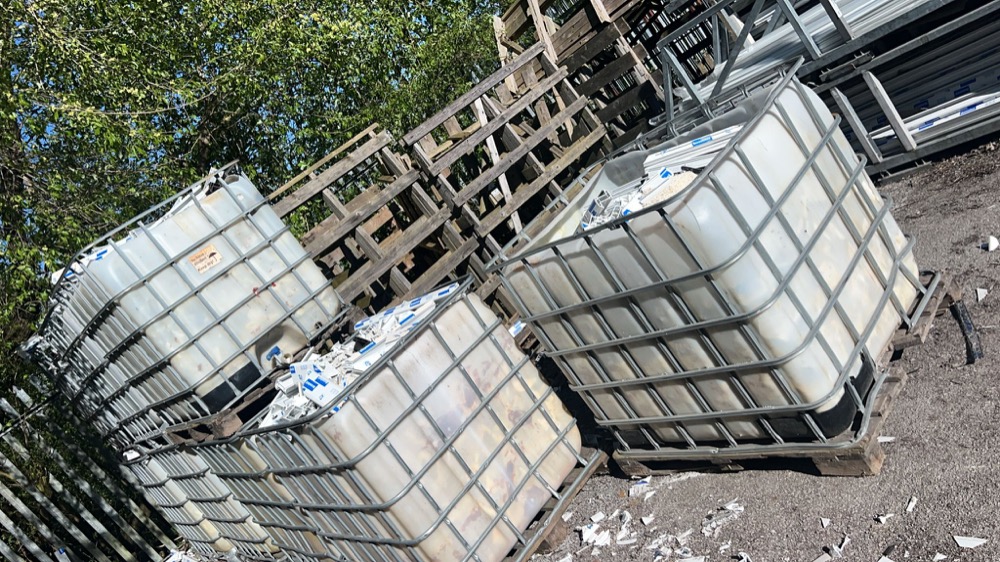
- Stillage cages. 1m³ to 2m³ steel mesh cages, sat next to the saw cell or trim station. Fabricators load directly. We swap full for empty. Suits smaller fabricators or an offcut-by-colour set-up.
- IBC-style bulk bins. Larger volume, similar idea. Good for high-throughput single-colour lines.
- Dedicated containers. 20yd or 40yd, placed on yard, filled over a set period. Suits high-volume operations where the loading dock can take the container.
- Loose loads. For occasional clearances or set-up changes — we send a vehicle, you load, we go. Lower rebate (no segregation guarantee) but flexible.
Most fabricators we work with run a hybrid: cages for the production cells (one per colour), an outdoor container for bulk QC reject profile and seasonal clear-outs.
Frequency and shift pattern
If you run two-shift production, you don't want a collection slot at 11am on a Tuesday — that's mid-cycle, the floor is live, the FLT driver is needed elsewhere. Sensible frequencies:
- Weekly for medium fabricators (5,000–15,000 frames a year). Cage swap, in and out in 30 minutes.
- Twice-weekly for high-volume sites or those tight on storage.
- Container exchange on a fill-trigger basis (you call when it's full) for larger operations.
Time slots should fit changeover, lunch break or end-of-shift — when the FLT and the foreman aren't fighting for it. We schedule around your operation, not the other way round.
Segregation discipline: where the value sits
The single biggest variable in the rebate you receive is how clean and how segregated the load is. A mixed cage with white, foiled and reinforced offcuts thrown together drops to general regrind value. A cage of single-colour, single-system, single-batch offcuts with no foreign bodies is feedstock-grade.
What contaminates a load:
- Steel reinforcement still inside the offcut. Costs us a separation step.
- Gaskets, brush pile, weather seals. Different polymer chemistry, downgrades the regrind.
- Glazing tape, butyl, silicone. Sticky contaminants that survive granulation.
- Mixed colours in what should be a white load.
- Non-uPVC plastics — polypropylene packaging, ABS hardware blanks, anything that's drifted in from the pack-out cell.
- Sweepings. Floor debris with concrete dust, swarf, cigarette ends — yes, we see all of it. A cage of clean offcuts beats two cages of "general factory waste" every time.
The granulator vs shredder distinction matters here. A shredder breaks material down by tearing — fine for mixed loads, low precision. A granulator cuts cleanly with a defined screen size, producing a uniform regrind that goes straight back to a compounder. Clean post-industrial offcuts go to the granulator route; contaminated material goes to the shredder route. The financial difference is significant.
Rebate structures: what makes a load high-value
We won't quote numbers in a blog (they move with the polymer market, and the BPF would rightly raise an eyebrow at any recycler quoting a fixed rate in print). But we'll be transparent about the variables:
- Volume. A consistent monthly tonnage gets a better rate than ad-hoc loads. We can plan logistics, route a dedicated vehicle, schedule onward delivery to the reprocessor.
- Segregation. Single-colour, single-grade beats mixed every time.
- Cleanliness. Steel-out, gasket-out, no foreign bodies.
- Traceability. System house, profile range, batch where you can supply it. Material with provenance is worth more.
- Format. Manageable lengths (sub-1m offcuts ideal), in stillages or bulk bags.
The rebate is a pass-through of the value the reprocessor pays us, less collection cost. The cleaner you make our job, the better the number that comes back.
What the eWTN paperwork actually does for you
Every collection generates an electronic Waste Transfer Note within 24 hours, satisfying Section 34 of the Environmental Protection Act 1990. For fabricators, the eWTN does three things: it discharges your duty of care for that load, it gives you the audit trail that ISO 14001, supply-chain disclosures and increasingly Scope 3 reporting all want, and it lets us aggregate your annual tonnage into the recycling reports your environmental team can hand to the system house, the principal contractor or the ESG audit. We also hold registration as an Environment Agency Upper-Tier Waste Carrier — number CBDU347776 — which is the minimum any carrier moving your offcuts off-site must have.
Why scrap dealers and skip hire are the wrong destination
Fabricators sometimes default to the local skip company because it's the easiest call to make. The problem isn't that it's illegal — properly licensed skip firms can carry uPVC waste — it's that the material almost certainly ends up in a mixed waste transfer station, where it's loaded into a general waste stream and routed to energy-from-waste, RDF (refuse-derived fuel) or, in the worst case, landfill.
You've taken a feedstock-grade single-stream polymer and turned it into general waste. That:
- Costs you the rebate you should have received.
- Costs you the recycling tonnage you should have reported.
- Removes your material from the closed loop entirely.
- Increasingly puts you on the wrong side of supplier audits — the system houses are starting to ask their fabricators where their offcuts go, and "in the skip" is becoming an awkward answer.
Same logic applies to the scrap dealer route. Most metals-led scrap operations don't have a granulation line for rigid PVC-U, and the material gets bulked, not processed. It's a missed opportunity at every level of the waste hierarchy.
The DEFRA waste hierarchy puts recycling above recovery (which is energy-from-waste) and recovery above disposal. A fabricator with a clean offcut stream sits at the very top of that hierarchy. A fabricator filling skips sits in the middle at best.
Setting up a programme: the practical steps
If you're not currently on a fabricator-grade collection programme, the move-over is straightforward.
- Site visit. We walk the floor, look at your saw cell layout, your storage footprint, your loading bay access, your shift pattern.
- Container plan. Cages by colour, container for bulk, vehicle access spec'd to your gates.
- Schedule. Slots that fit your shift change, not ours.
- Paperwork. Master service agreement, eWTN flow set up, your environmental team copied in.
- Rebate review. First three months of loads weighed and graded — we agree a rate that reflects the actual material profile coming through.
The first month is always a calibration. By month three the rate is settled, the scheduling is invisible, and you've got a clean, traceable, compliant offcut stream that's earning you money instead of costing you skip charges. For the cost picture on alternatives, our UK uPVC disposal cost guide sets out what skip-route disposal actually costs once you load in compliance and lost rebate. For the wider context on where your material ends up, see what happens to old uPVC windows and our landfill-to-closed-loop piece.
Five hubs, fabricator-friendly logistics
We run from Chester, Wigan, Haslingden, Stoke-on-Trent and Rotherham — covering the North West, Midlands, Yorkshire and beyond. Most of the UK fabricator base sits inside a one-hour drive of one of those hubs, which means same or next-day capability and a vehicle that's not running half-empty. See locations for the hub closest to your unit, or read more about what we collect on the homepage.
Send photos of your current set-up — saw cell, cage, container, loading bay — and we'll come back with a collection plan and an indicative rebate band the same working day. Call 0330 043 5543 or email info@upvcrecycling.com.